
Recently, the research group led by Prof. Xiang Yuan at East China Normal University observed giant circular dichroism arising from particle-hole symmetry breaking in the magnetic topological material Sb-doped MnBi2Te4. The team theoretically proposed a new mechanism in which a strong magnetic field induces particle-hole symmetry breaking, causing the system to respond exclusively to one circular polarization of light. To verify this prediction, the researchers developed a polarization-resolved magneto-infrared system capable of operating under strong magnetic fields. Using this instrument, they successfully observed giant circular dichroism that is two orders of magnitude stronger than that found in existing materials and extends over an exceptionally broad spectral range. The scientific discovery was published in Nature Materials under the title “Giant and Broadband Circular Dichroism from Particle-Hole Symmetry Breaking in Weyl Semimetals”, while the development of the polarization-resolved in-situ high-magnetic-field infrared optical system was reported in Advanced Scientific Instruments.
Circular dichroism (CD) is an important physical quantity for characterizing chirality and symmetry breaking in materials and has broad applications in condensed matter physics, chemistry, and life sciences. However, the degree of symmetry breaking in conventional magnetic materials, chiral crystals, and artificial metamaterials is typically limited, resulting in weak CD signals confined to narrow spectral ranges. Achieving strong and broadband circular dichroism has therefore remained a major challenge.
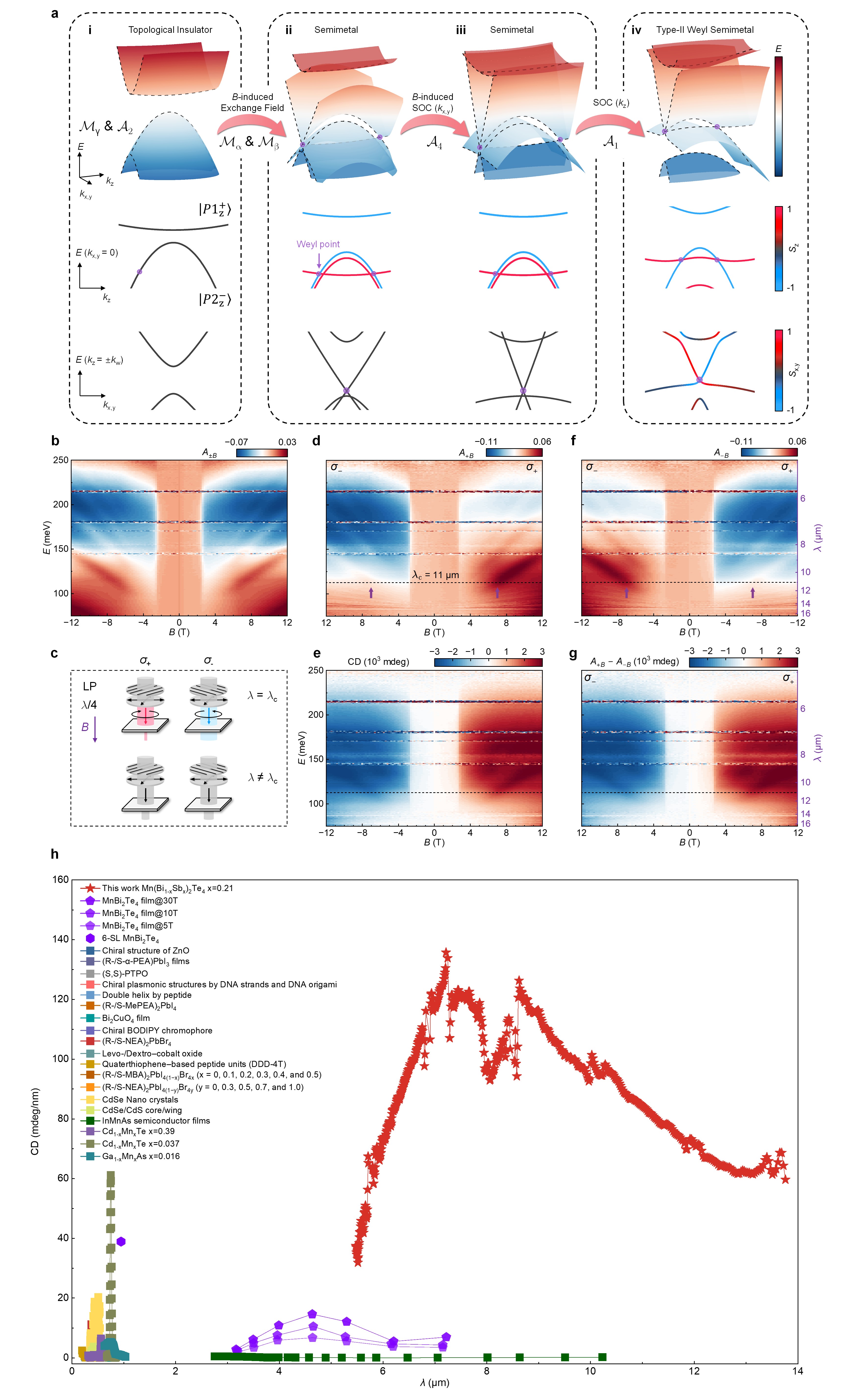
The research team theoretically predicted that Mn(Bi,Sb)2Te4 undergoes a phase transition from an antiferromagnetic topological insulator to a type-II Weyl semimetal under a strong magnetic field, accompanied by pronounced particle-hole symmetry breaking. The magnetic field introduces Landau quantization, while band-nesting effects further enhance interband transitions near the Weyl nodes, extending the optical response throughout the target infrared spectral range. Calculated optical conductivity spectra revealed that optical absorption in Mn(Bi,Sb)2Te4 is almost entirely contributed by a single chiral channel, whereas the opposite chiral channel is strongly suppressed over the entire energy range. Symmetry analysis further showed that particle–hole symmetry constrains optical transitions between Landau levels related by particle–hole conjugation. Consequently, the strong breaking of this symmetry is directly responsible for the emergence of circular dichroism.
To experimentally verify these predictions, the team independently developed the first polarization-resolved in-situ high-magnetic-field infrared optical spectroscopy platform. This instrument overcomes key technical limitations of conventional approaches and enables circular-polarization-resolved infrared spectroscopy under strong magnetic fields. Using this setup, the researchers observed spectral-weight transfer near the magnetic phase-transition field and clearly resolved Weyl-fermion Landau-level transitions at high magnetic fields through magneto-infrared absorption and differential spectroscopy measurements on high-mobility Mn(Bi,Sb)2Te4 samples. Exploiting the circular-polarization-resolved capability of the system, they further discovered dramatically different absorption responses for left- and right-handed circularly polarized light. Experiments revealed a broadband circular dichroism signal spanning the 6-13 μm wavelength range, with a maximum magnitude reaching 3240 mdeg. Measurements performed under opposite magnetic-field directions and opposite circular-polarization configurations further confirmed that the observed effect originates from the intrinsic chiral electronic states of the material.
Ultimately, the experiments demonstrated giant circular dichroism that is approximately two orders of magnitude stronger than previously reported materials (~130 mdeg nm-1) while covering an exceptionally broad spectral range. This work highlights the critical role of particle-hole symmetry in controlling topological quantum materials and provides a new route for realizing optical chirality. Moreover, the newly developed in-situ polarization-resolved high-magnetic-field infrared spectroscopy platform offers a powerful experimental tool for future studies of quantum materials under strong magnetic fields.
For the Nature Materials publication, Ph.D. students Xiangyu Jiang and Yuhan Du from East China Normal University, postdoctoral researcher Zeping Shi from East China Normal University, and Ph.D. student Haonan Chen from Fudan University contributed equally as co-first authors. Prof. Xiang Yuan (East China Normal University) and Prof. Cheng Zhang (Fudan University) served as co-corresponding authors. For the instrumentation paper, Zeping Shi, Wenbin Wu, Zhiwei Zhang, Yuhan Du, and Chenyao Xu contributed equally as co-first authors, and Prof. Xiang Yuan served as the corresponding author.
These work was supported by the National Natural Science Foundation of China, the Ministry of Science and Technology of China, the Ministry of Education of China, the Shanghai Municipal Government, and other fundings.
Nature Materials:https://doi.org/10.1038/s41563-026-02630-6
Adv. Sci. Instrum.:https://doi.org/10.1016/j.asi.2026.100005